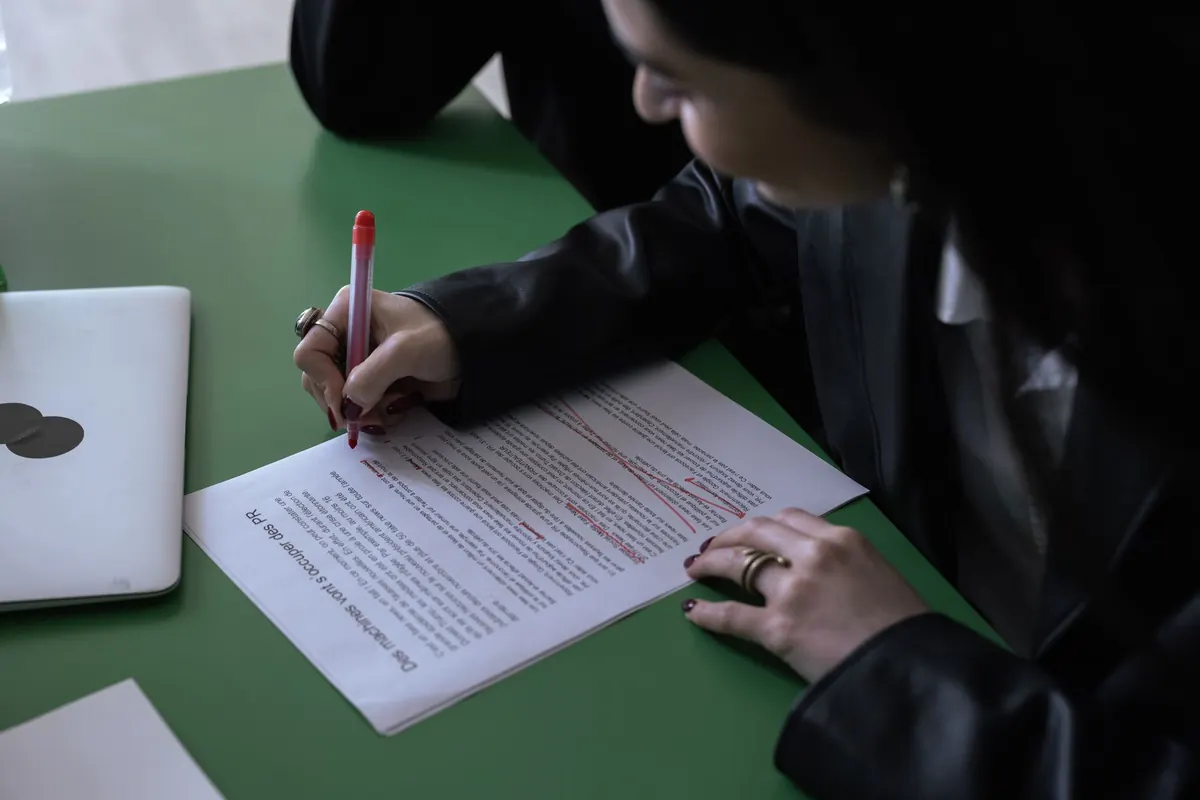
Most poems are not finished in one sitting. They are finished by asking the same handful of questions, again and again, until the answers stop being clever and start being true. A checklist will not write the poem for you. What it does is give you a way back in when you have read your own draft so many times that the words have gone smooth and meaningless.
Here are ten questions worth asking of any draft, followed by notes on how to use them without sanding away the thing that made the poem yours.
Before editing, read the poem out loud twice. Once at normal pace, once slowly. Do not stop to fix anything. Just notice:
That last one is the poem's pulse. Mark it with a pencil. Whatever else you do in revision, protect it.
Work through these on a printed copy with a pen, not on a screen.
Imagery usually fails in one of two directions: too vague, or too crowded. Vague looks like the sky was sad. Crowded looks like three metaphors stacked on one small moment, each elbowing the others out of the way.
A useful test is to ask what a camera would see. The sky was sad gives it nothing. Rain ticking off the bins behind the flats gives it a frame, a sound and a place — and leaves the sadness where it belongs, with the reader.
Then check the count. In a short poem, one image developed over several lines will usually beat five quick ones. If you have written a list of comparisons, choose the two that feel inevitable and cut the rest. If a description could be swapped into any other poem about the same subject, it is furniture, not evidence.
Watch the adjectives, too. Most of the time you can drop one and the noun stands up straighter. The same goes for adverbs attached to verbs of movement: walked slowly is weaker than shuffled, and longer.
The line is the poet's instrument. Prose runs to the margin; a poem decides where to stop, and every stop is a small act of emphasis.
Compare:
I told her I would come back before the frost
I told her I would come back
before the frost
The second version makes the reader hold come back for a beat. That pause is meaning. Neither version is automatically better, but they are not the same poem, and you should know which one you have written.
Sound works the same way. Read for clusters of consonants that slow you down, and runs of vowels that hurry you along. Rhyme and half-rhyme do not have to be regular to be useful; they have to be deliberate. If a rhyme forces a word you would never choose, the sound is writing the poem instead of serving it.
White space is part of the score. A stanza break is a breath. Ask what that breath is for. If you cannot say, it may not need to be there.
Revision has a failure mode: the poem gets cleaner and smaller, and something goes missing. Usually it is the odd word, the slight grammatical wobble, the image that is strange but true. Those are often the parts a reader remembers.
So when a question on the list tells you to cut, ask one more thing: is this a flaw, or is this me? A mixed metaphor that shows how your mind actually jumps may be worth keeping. A clumsiness that exists only because you have not read the line aloud is not.
Keep the original draft. Some cuts should be tested rather than made permanent. Give it a week, read both versions, and trust your ear over your rulebook.
If you want something practical to do tonight, try this:
A poem rarely needs everything fixed at once. It needs the next honest question. Ask it, answer it, and come back tomorrow. That is how drafts become poems — not in a burst of inspiration, but in a series of small, deliberate decisions you were willing to make.
Photo: cottonbro studio / Pexels

Why the British tell ghost stories at Christmas, and how to write your own — from cold settings and quiet dread to a...

Build a daily reading habit in thirty days with a simple plan: ten-minute sessions, short stories, essays and poems,...
Seasonal prompts and practical techniques for writing autumn essays about change, memory and transition in Britain —...

A new story every day for readers..
