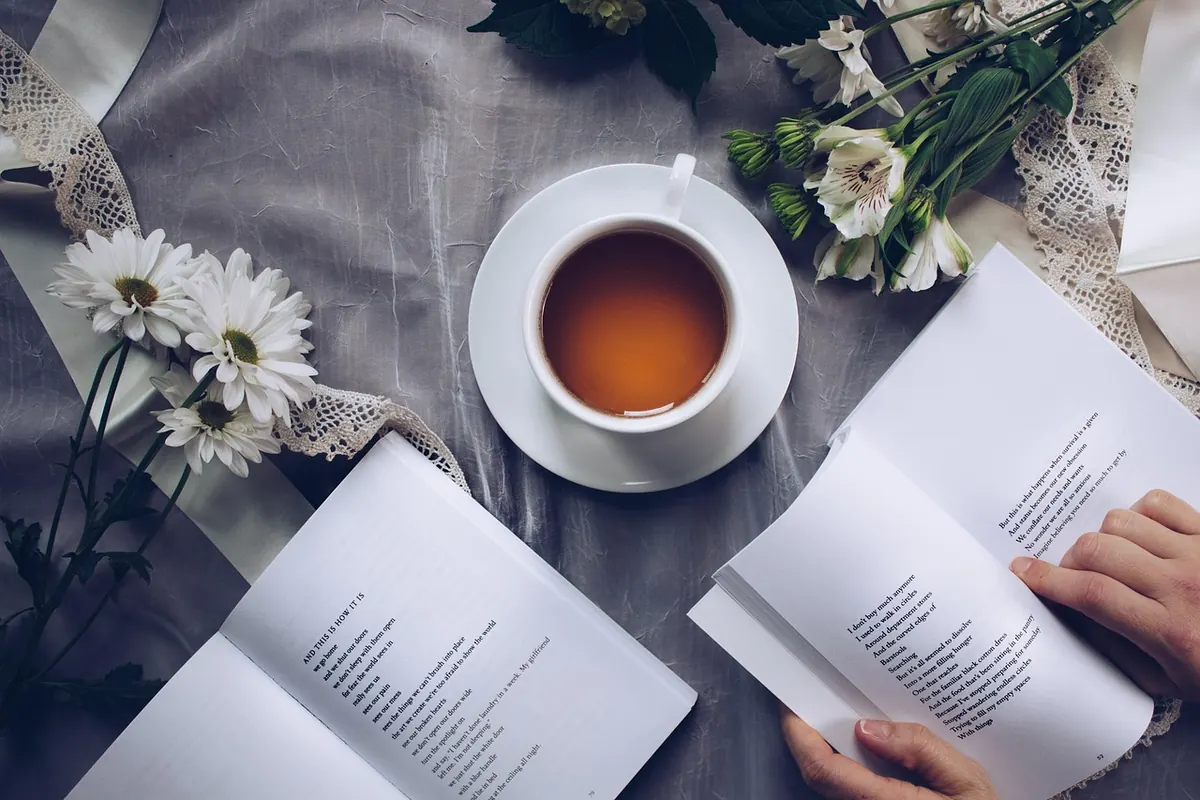
A prose poem walks into a room and nobody can decide what to call it. It looks like a paragraph and behaves like a poem. It has no line breaks to hide behind, none of the white space that tells a reader where to pause and breathe. Everything it does, it has to do with sentences.
If you have ever read a short block of text that felt unmistakably poetic despite having no visible poetry about it, you have probably met one. Here is what is going on.
A prose poem is a poem written in sentences and paragraphs rather than lines and stanzas. It looks like prose on the page, but it works like poetry: it leans on rhythm, image, sound and compression rather than on plot or character development.
That sounds tidy. In practice it is slippery, because the form has no fixed rules about length, subject or shape. A prose poem can be one sentence. It can run to a page or two. It can tell a story, describe a dream, argue with itself or simply hold one image up to the light.
What holds it together is attention. Every sentence has to earn its place, the way every line does in a conventional poem. Cut a sentence from a good prose poem and you feel the loss, the way you would feel a missing line in a sonnet.
At the edge of town there is a street where the lamps are always lit, even at noon. My grandmother lived there once. The river passes behind the houses without making a sound, and the bell in the tower rings for no one, all day, all night, and nobody in the town seems to notice.
That is a prose poem, or the opening of one. No line breaks. But the repetition, the deliberate pacing and the refusal to explain itself all do the work that line breaks would normally handle.
The form has French roots. Aloysius Bertrand's Gaspard de la nuit, published in 1842 after his death, is often named as the first real collection of prose poems, and Baudelaire's Le Spleen de Paris, written across the 1850s and 1860s, set the template: short, strange, urban pieces that mixed everyday observation with something closer to music than to storytelling.
Rimbaud pushed it further. In the twentieth century, poets writing in English took it up with enthusiasm: Gertrude Stein's experiments, Russell Edson's deadpan fables, Charles Simic's compressed dream-logic, and the lyric fragments of many contemporary writers. In Britain, the prose poem turns up regularly in magazines and anthologies, sometimes labelled, sometimes not.
One thing worth knowing: critics have argued for well over a century about whether the prose poem is a proper genre or just a technique. That argument has never been settled, and it does not need to be. The form survives because poets keep finding things to do with it that nothing else quite manages.
If you want to understand a prose poem from the inside, look for these qualities:
The prose poem is also unusually friendly to subjects that resist narrative. A mood, a piece of weather, a memory that will not sit still, an overheard remark that keeps bothering you. These are difficult to shape into stories and awkward to break into lines. In a prose poem, they can simply be.
This is the question beginners ask most, and it is fair. Both forms are short, both sit in blocks of text, and both are often published side by side. Flash fiction is generally understood as a complete story under roughly a thousand words, with characters, a situation and some kind of change. A prose poem may contain all of those things, or none of them.
Here is a practical test. Ask what the piece would lose if you stripped away the language.
None of this is law. Plenty of pieces sit happily in the overlap, and editors disagree all the time. The test is a guide, not a gate. If a piece works, it works, whatever the label on the tin.
Start with one image and no plan. A clothes line in February. A lift that stops on a floor it should not. Your father's handwriting on an old receipt. Write it down in sentences, and resist the urge to turn it into a story with a beginning, a middle and an end.
Then read it aloud. This is the single most useful habit for prose poetry, because without line breaks your ear is the only instrument you have. Listen for sentences that run too long, words that repeat by accident rather than design, and moments where you hear yourself explaining. Cut those.
Three more things that help:
Aim for a first draft of 100 to 300 words. You can always trim. Most beginners overwrite, and the form rewards the opposite.
To train your ear, read widely and slowly. Baudelaire and Bertrand are worth your time, as are the twentieth-century writers who made the form their own. Read each piece twice: once for the sound, once for the sense. Notice where you were moved and try to work out which sentence did it.
If you want to publish, look for magazines that print both poetry and short fiction and read their submission guidelines carefully, since some specify a maximum length for prose poems and others fold them into general poetry sections. A cover note that simply says "prose poem" is usually enough.
And if the form still feels slightly unsettling, that is not a problem to solve. A paragraph that behaves like a poem is meant to make you read differently, a little more slowly, with your attention tuned to language rather than plot. That small shift in how you read is the whole point, and it is available to anyone with a page and a few spare minutes.
Photo: ThoughtCatalog / Pixabay

Why the British tell ghost stories at Christmas, and how to write your own — from cold settings and quiet dread to a...

Build a daily reading habit in thirty days with a simple plan: ten-minute sessions, short stories, essays and poems,...
Seasonal prompts and practical techniques for writing autumn essays about change, memory and transition in Britain —...

A new story every day for readers..
