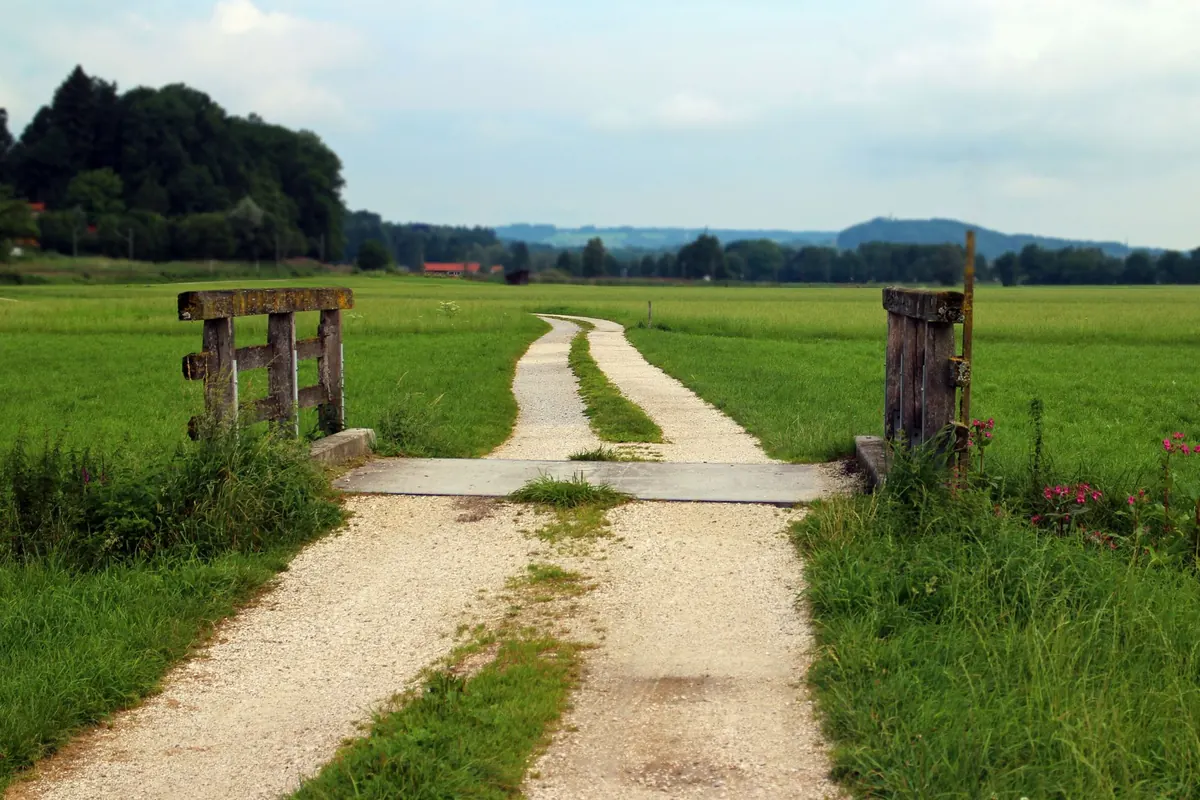
You already know things about your local landscape that no visiting poet could guess: which pavement floods first after heavy rain, where the wind funnels between two terraces, the exact point on the walk to the shop where the smell of the river reaches you. That knowledge is the raw material. The work is turning it into lines that let a stranger feel the place too.
This is a guide to doing that — not writing about “the countryside” or “the city”, but about the particular square mile you live in.
Generality is the enemy. “Rolling hills” and “bustling streets” could be anywhere, which means they are nowhere. A poem becomes local the moment it names something only a local would know: the bus that runs once an hour, the bench with a missing slat, the shopfront that has been three different businesses in five years.
So before you write a line of verse, make a list of twenty things you can see, hear or smell within a ten-minute walk of your front door. Not “trees” — the sycamore leaning over the alley. Not “traffic” — the whine of a delivery van reversing at seven in the morning.
Specificity isn’t decoration. It’s how a poem earns belief.
Landscapes come with their own vocabulary, and much of it is already poetry. In parts of the north, a narrow passage between houses is a ginnel or a snicket. In Scotland you might have a burn, a brae, a howe. Coastal towns have their own terms for tide and shingle; industrial places have words for spoil, sidings, cut and fill.
Keep a notebook — paper or phone, whichever you’ll actually use — and write down:
You needn’t use all of it. But a poem that borrows two or three real local words will sound like it belongs to a particular postcode.
British weather is not a backdrop; it’s a character. It changes what a place is. The same park in July and in February barely resembles itself. Rain flattens a sentence; a gale breaks it up. Fog makes lines vague and slow. Sunshine encourages a poem to open out.
Try writing the same six-line description of your street three times: once in drizzle, once in a heatwave, once in the week after a storm. You’ll notice your sentence lengths shifting on their own. That’s useful. Rhythm is meaning.
Pay attention to light as well. Northern light in winter is low and silver for a few hours; eastern coasts get sharper mornings. Write down the times. “The lamp comes on at ten past four” fixes a poem in a season more firmly than any adjective.
Form is a tool, not a test. Match it to the thing you’re describing.
If you’re stuck, borrow a structure you already know — a hymn metre, a folk song, a nursery rhyme — and pour the place into it. You can loosen it later.
Landscape is never empty. Even a field has a history of hedges, ditches and ownership. Look for the traces: a stile that leads nowhere, a footpath sign pointing across a dual carriageway, initials scratched into brick, the concrete base of something removed.
These details let you write about change without making speeches. Instead of telling the reader that a town has altered, show them the new estate built on the old playing field, and let the reader do the rest.
Some words have been used so often they’ve gone numb. Before you finish a draft, search it for rolling, babbling, nestled, quaint, majestic, tranquil, patchwork, hustle and bustle. If one appears, replace it with something only you could have noticed. “The brook babbled” becomes “the brook worked its way under the road and came out brown.”
Write a messy first version without stopping. Twenty minutes, no editing. Then leave it for a day.
When you return, read it aloud. Your ear will catch what your eye missed: lines that sag, rhymes that clang, a phrase that only works on the page. Cut anything that could be said about any town in Britain. Keep anything that could only be said about yours.
Two or three revisions is usually enough for a short poem. Read the final version to someone who knows the place. If they say “that’s exactly it”, you’ve got it. If they ask which bit you mean, you haven’t been specific enough yet.
Take a fifteen-minute walk you’ve taken a hundred times. Sit somewhere for five of those minutes and write down ten concrete observations — no adjectives allowed. Come home, choose the three that surprise you most, and build six lines around them. Don’t worry about whether it’s a poem yet. Get the material down, then shape it.
Do that once a week and you’ll have a small map of your area in verse by the end of a season. Which is what local poetry is, in the end: a record of paying attention, in a place nobody else will describe quite the way you can.
Photo: Pixabay / Pexels

Why the British tell ghost stories at Christmas, and how to write your own — from cold settings and quiet dread to a...

Build a daily reading habit in thirty days with a simple plan: ten-minute sessions, short stories, essays and poems,...
Seasonal prompts and practical techniques for writing autumn essays about change, memory and transition in Britain —...


A new story every day for readers..
